
This post has been brought to you by Rhum Barbancourt . All opinions expressed are my own. The following message is intended for those 21+. Please enjoy responsibly.
Today we're sampling a Haitian rum, the Reserve Speciale Rhum via Barbancourt. In addition to reviewing the rum itself, we'll be talking about how to spot a good rum, and some of the the best ways to enjoy today's rum.


Romancing the Sugarcane - The Basics of Rum
Rum is the result of fermenting sugarcane molasses or sugarcane juice. The fermented liquid is then distilled. The distillate is then - usually - aged. Higher quality rums are aged in oak barrels, ideally used bourbon barrels. However, aging can also be performed in steel vats as well as other types of wooden containers.
The aging process, provided it takes place in oak barrels or other similar wooden containers, is where rum derives its characteristic amber color. Naturally, if rum is aged in steel vats, or other metal contains, it will remain colorless. After aging, blending is typically done. The blending process is essentially how brands or labels achieve a consistent taste. This is also where the color of the rum is adjusted, either lightening dark rums by blending in lighter rums, or further coloring darker rums with caramel, or filtering out any remnant color from light rums that may have overly darkened during aging.
Most of the world's rum is produced in the Caribbean and South America. However, rum - as well as other liqueurs that are almost indiscernible from rum - are produced pretty much everywhere sugarcane is grown. Large quantities are produced, for example, throughout parts of Asia such as the Philippines, as well parts of Africa such as Madagascar and Reunion Island.

Standards, regulations, and local preference means that there's a wide world of rum available for enthusiasts to enjoy. However, this also makes nailing down precisely 'what' rum is almost impossible, since what qualifies as 'rum' in one jurisdiction might fail to make the grade in another.
However, rum is generally broken down and marketed via 'grades.' These include such classifications as Dark, Light, Premium, and Spiced Rums, the names of which are largely self-explanatory. Light rums, however, tend to have very little flavor aside from sweetness, and are typically used in cocktails as opposed to being consumed on their own or paired with food. Other varieties include Overproof Rums, which can contain in excess of 80% alcohol by volume. Again, these rums are typically used in cocktails. One interesting class of rum is Brown Rum, which is aged in charred barrels, and have a flavor closer to whiskey than the flavors one might typically associate with rum.

Finding a Good Rum - What to Look For
Unlike whiskey, it is intensely simple to know if you've got a 'good' rum on your hands.
To start, rum should never be 'cloudy.' Cloudy rums are good for one thing and one thing only - pouring down the drain. White rums should be clear, not unlike vodka, while darker rums should be varying shades of amber. Some darker rums will appear redder others, while the darkest of rums can appear 'amber-brown,' with some bordering on 'black.' Generally, however, regardless of how dark rum might appear, the color should fall somewhere along the 'amber spectrum.'
In terms of taste, rum should 'not' taste of ethanol. Unlike vodka or certain astringent sakes, 'alcohol' should be at most a background flavor. In the very best rums, alcohol should be barely - if at all - perceptible. If rum 'burns' or is 'sharp' tasting, or has any astringency, this is indicative of a low-quality rum. Instead, quality rums should be 'pleasant' or even 'festive' on the palate, with a complex bouquet of tastes ranging from sweet to smoky, carried on a delicate or 'smooth' texture.

Tasting and Aromatics - The Review
With all of that out of the way, let's taste today's rum.
The Reserve Special by Barbancourt (usually called 5-star by consumers), is an Agricole rum, meaning its produced from cane juice. This particular Agricole is produced from a mix of cane juice and cane juice syrup.
Rums made from sugar cane juice typically have earthy or grassy notes coming off the top of the bouquet, creating a fresh bouquet. Here, however, the rum features light caramel notes, with what I'll describe as toffee or white pepper. Ethanol comes through towards the back of the bouquet, which I suppose isn't surprising given the rhum's higher-than-usual proof.
On the palate, the rhum initially greets with notes of crisp white apple, before giving way to the expected brown sugar and vanilla essences, carried on a smooth texture. The makers claim they want a smooth, approachable rum, and I believe that's what they've achieved.

How to Enjoy Today's Rum
Mixing. As with most lighter rums, I'm of the opinion that this bottle is at home when used for mixing drinks. Here are few suggestions that, I believe, play to this particular rhum's strengths…
1) The Rhum Club. This drink is a combination of simple syrup, orange bitters, lime juice, and rhum. Combine the ingredients, strain into a chilled cocktail glass, with or without ice, and garnish with a lime wedge. Decorative umbrella optional, but encouraged.
2) Tour Le Carbet. A tried-and-true classic for rhum Agricole fans. Combine rhum, lime, falernum, and suze in a shaker with ice. Shake, and then strain into a chilled glass. Enjoy.
3) The Ti Punch. Mix rhum, cane syrup, and a disc of lime in a glass, serve either straight or on the rocks. Simple.
4) Neat. Today's rhum works fine for sipping on its own, either straight or on the rocks.
Spiced Hot Toddy
- Total Time: 10 minutes
- Yield: 1 hot toddy 1x
Ingredients
- 1.5 ounce Rhum Barbancourt (or any brown liquor such as brandy or whiskey)
- 1 tablespoon honey
- 1 cup hot water
- 1/4 teaspoon pure vanilla
- 1 cinnamon stick
- 2 star anise
- 2 orange peels
- Orange slices, for garnish
Instructions
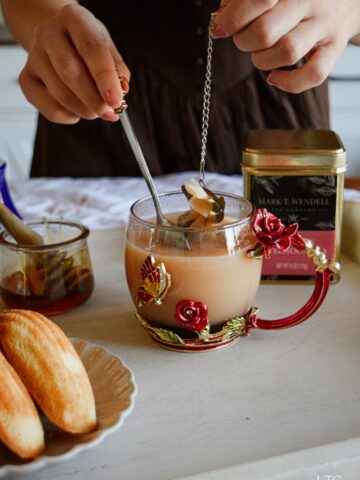
- In a small saucepan, combine water, vanilla, star anise, cinnamon stick, and orange peels. Bring to a boil.
- In your desired mug or glass, add honey, Rhum Barbancourt, and spiced hot water. Stir to combine.
- Garnish and serve!
- Prep Time: 5 minutes
- Cook Time: 5 minutes
Claudia Krusch says
It looks like the perfect fall drink! Love all the ingredients! I can't wait to try it!
Jupiter Hadley says
I have never heard of this drink before but it sounds perfect for wintertime! Thank you for this recipe.
Rosey says
It sounds so proper to me. 🙂 Come on in and enjoy a hot toddy... Perfect for this chilly weather!
Marysa says
I've never had a hot toddy, but I've heard it is a good drink! I will have to give this a try sometime. It would be fun to make it for when we have guests.
Sue-Tanya Mchorgh says
Sampling Haitian rum, especially the Reserve Speciale Rhum via Barbancourt, sounds like an exciting journey into the world of spirits. It's wonderful that the post includes not only a review of the rum but also valuable insights on how to identify a quality rum and creative ways to savor it. Plus, the responsible enjoyment reminder is a responsible touch. Looking forward to learning more about this Haitian gem and its various facets. Cheers to exploring new flavors and experiences!
Nikki Wayne says
This sounds so good! I want to give the recipe a try. My husband will love this for sure.
MELANIE E says
This is such a lovely warming drink and ideal in the cooler weather. We often make these when my husband and I have chest colds as they can help.
Marie Cris Angeles says
Sounds like this Spiced Hot Toddy is great and tastes good. Not a super fan of hot rum, but I'd like to try this.
Lavanda Michelle says
Your explanation of the basics of rum and what to look for in a good rum is highly educational. It's refreshing to learn about the various types of rum and how to identify a quality one
Samantha Donnelly says
I do like rum, and never thought to have it in a hot toddy before, Definitely going to try this