
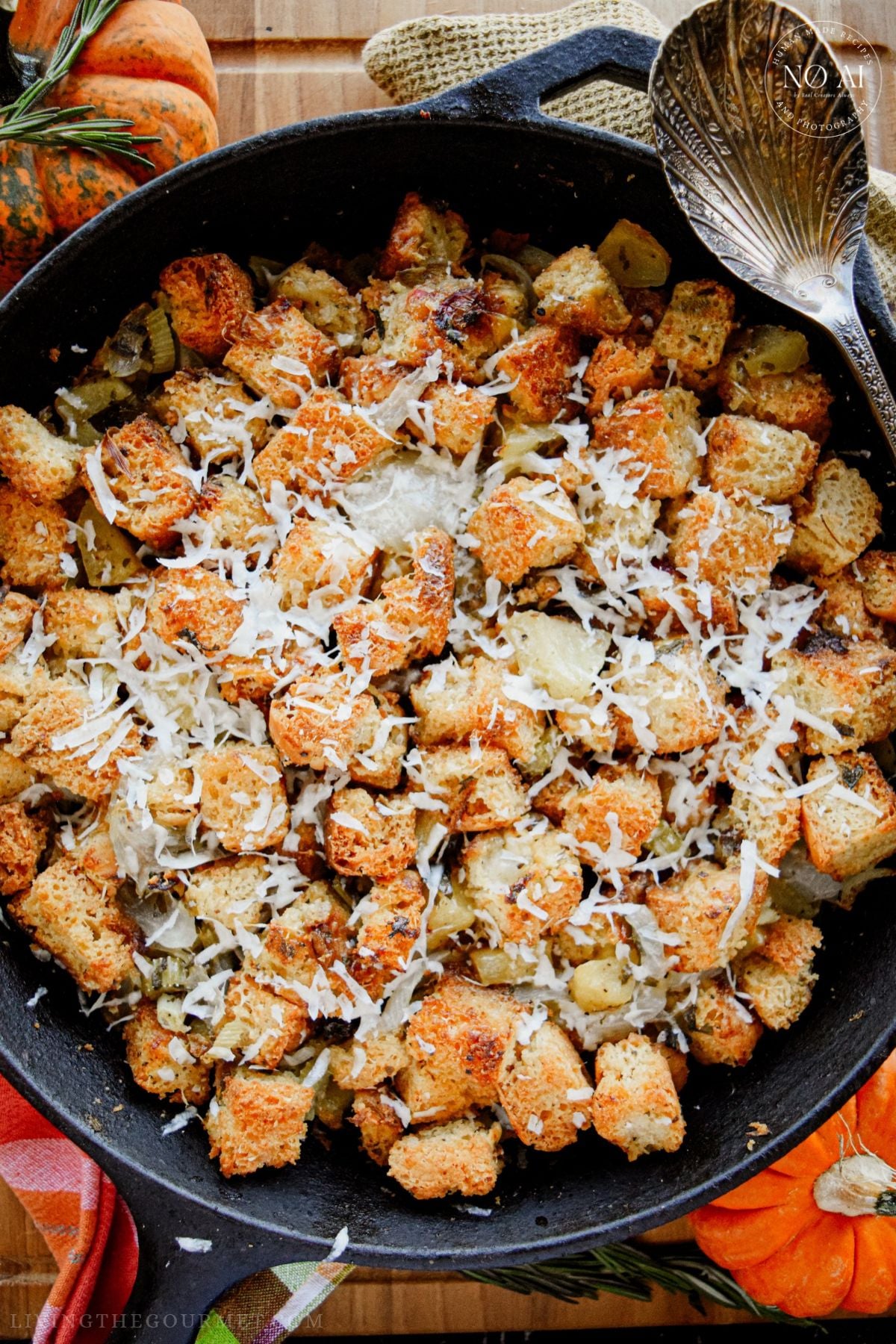
If you've ever hosted a large Thanksgiving gathering, chances are you've found yourself with more leftover stuffing than you can possibly eat over the course of a few days. And this is a problem, since stuffing only lasts a few days in the fridge. The good news is that stuffing freezes surprisingly well, provided you store it properly and then reheat it properly.
Jump to:

Quick Answer
Yes, you can indeed freeze leftover stuffing. To freeze it properly, let it cool in the fridge for a few hours, then pack it in an airtight container or sealed freezer bags. Stuffing is best frozen within 3 to four days of cooking. Frozen stuffing retains its quality for about 1 to 2 months in the freezer. To reheat, give it a splash of broth and then heat it covered in the oven at 350 degrees f until it reaches 165°F at the center, then continue heating uncovered for 10 minutes to crisp the top.
Why Stuffing Freezes Well
The honest truth is that stuffing is mostly bread, bread combined with fat, broth, and seasoning. All of these ingredients hold up well in the freezer. Unlike dishes with dairy-heavy sauces or delicate vegetables, stuffing doesn't separate or turn watery during the thawing process. Yes, it can dry out slightly, but a little extra broth during reheating (as mentioned above) brings its moisture right back.
How to Freeze Leftover Stuffing
- Cool it Quickly: Refrigerate the stuffing within 2 hours of serving. If you plan to freeze your stuffing, spread it in a shallow container or baking tray so that it cools faster.
- Remove it from the turkey: If the stuffing was prepped inside the bird, scoop it all out before storing. Never refrigerate or freeze stuffing while it is still inside the turkey, as this violates food safety. Bacteria grow rapidly inside the turkey, even a cooked turkey, and this will infect the stuffing if it is left inside, and no amount of reheating will make the stuffing safe to eat again.
- Portion It: Divide the stuffing into portions that you will actually use. This could be family-size portions or single servings.
- Pack it airtight: I recommend using freezer-safe containers or heavy-duty freezer bags. What matters is that they are airtight. Bags can be flattened to save space in the freezer, and they also generally allow the stuffing to thaw faster.
- Label and Date: Label everything you freeze, and that includes leftover stuffing. Write the date and the contents on each container or bag.
Freeze the stuffing as soon as you know you won't eat it in the next day or two. Stuffing that has been frozen the day of tastes much better than stuffing that has sat in the fridge for days before being frozen.
The Muffin Tin Method
The easiest way to portion and freeze stuffing is to use the muffin tin method. This means pressing any leftover stuffing into a well-greased muffin tin. Then, freeze the stuffing portions until firm, pop the portions out of the muffin tin, and set them in a freezer bag or freezer-safe airtight container. Each stuffing muffin or stuffing
Puck is a single serving and reheats very quickly. These make for delicious sides for grilled chicken, fried eggs, or steak.

How Long Does Stuffing Last?
- Refrigerator: 3-4 Days
- Freezer: 1-2 months for best quality
Frozen stuffing stays safe longer than two months if kept at 0°F, but 'safe' and 'tastes good' are two separate things. Stuffing keeps its quality best for about one to two months in the freezer, but after the two-month mark, its texture begins to suffer noticeably.
How to Reheat Frozen Stuffing
In the Oven (best for larger portions)
- Preheat the oven to 350°F.
- Spread the stuffing in a baking dish.
- Drizzle with broth about 2 to 4 tablespoons per cup of stuffing to restore moisture.
- Cover tightly with foil and bake for 20 to 30 minutes if thawed or 35 to 45 minutes if frozen.
- Uncover and bake another 10 minutes to crisp the top.
- Check that it has reached about 165°F in the center.
In a skillet (best for crispy edges)
Start off by melting some butter in a skillet over medium heat. Then add the thawed stuffing. Press it into an even layer across the skillet and cook for 4 to 5 minutes or until browned on the bottom. Flip in sections and brown the other side. Don't worry about flipping it neatly; a gentle fold to turn it over in sections is fine. Add a splash of broth if it seems dry.
In the Microwave (Fastest)
While I do not personally recommend heating the stuffing in a microwave, as it forfeits the crispy top - it is certainly possible to do, and is quick. Here's how.
Set the stuffing in a microwave-safe dish, sprinkle with broth, cover, and then heat at 50% power in 1-minute intervals, stirring between each, until hot throughout. You will lose the crispy top, but it's quick.
Which Stuffings Freeze Best?
- Bread Stuffing: This is the best stuffing for freezing. It reheats beautifully and keeps its texture well on reheating.
- Sausage Stuffing: Excellent for freezing. The fat from the sausage actually helps to keep the stuffing moist through thawing and reheating.
- Cornbread Stuffing: Freezes well, though it can become a bit more crumbly through the thawing and reheating process.
- Wild Rice or Grain Stuffing: These stuffings freeze relatively well, though the rice may soften somewhat through the thawing and reheating process.
- Oyster Stuffing: Not recommended. Cooked seafood, in general, loses its texture in the freezer. In addition, reheating can make oysters rubbery. Eat oyster stuffing fresh.
- Stuffing with Fresh Fruit: Apples and pears lose their texture in the freezer. While it is still fine to eat, expect the fruit to have softened in the freezer.
Freezing Make-Ahead Stuffing
If you want to freeze stuffing that you plan on making ahead, you can freeze it unbaked, and then cook it after thawing to preserve its texture. To do this, begin by assembling the stuffing in a freezer-safe baking dish. Wrap it tightly, and then freeze for up to 1 month. Thaw the stuffing overnight in the fridge - as a matter of food safety, do not attempt to rush the thawing process - and then add 10 to 15 minutes to the baking time.
For a shorter lead time, see our guide on making stuffing a day ahead.
Signs Frozen Stuffing Has Gone Bad
Throw out your frozen stuffing if you notice any of the following:
- An off or sour smell after thawing
- Mold anywhere on the stuffing
- A slimy texture
- Freezer burn anywhere on the stuffing, which appears as dry, grayish-white patches. While light freezer burn isn't usually unsafe, I do personally recommend throwing away the stuffing if you notice any amount of freezer burn. A few helpings of stuffing simply aren't worth the risk.
Bottom Line
In general, leftover stuffing freezes beautifully, with only a handful of exceptions as mentioned above. Let the stuffing cool, pack it right in either an airtight container or freezer bag, and use it within 1 to 2 months. When you are ready to use it, reheat it covered with a little extra broth until it reaches 165°F, then uncover to let the top become crispy again. With just a little planning, Thanksgiving leftovers can become an easy side dish weeks later.
For more Thanksgiving guidance, see our Can You Freeze Cranberry Sauce guide and our advice on How Much Turkey Per Person.

Leave a Comment